Online safety
How to spot reward-task scams in Nigeria
By Watch and Win · Updated
A practical checklist for unexpected messages, unlock fees and suspicious reward balances.
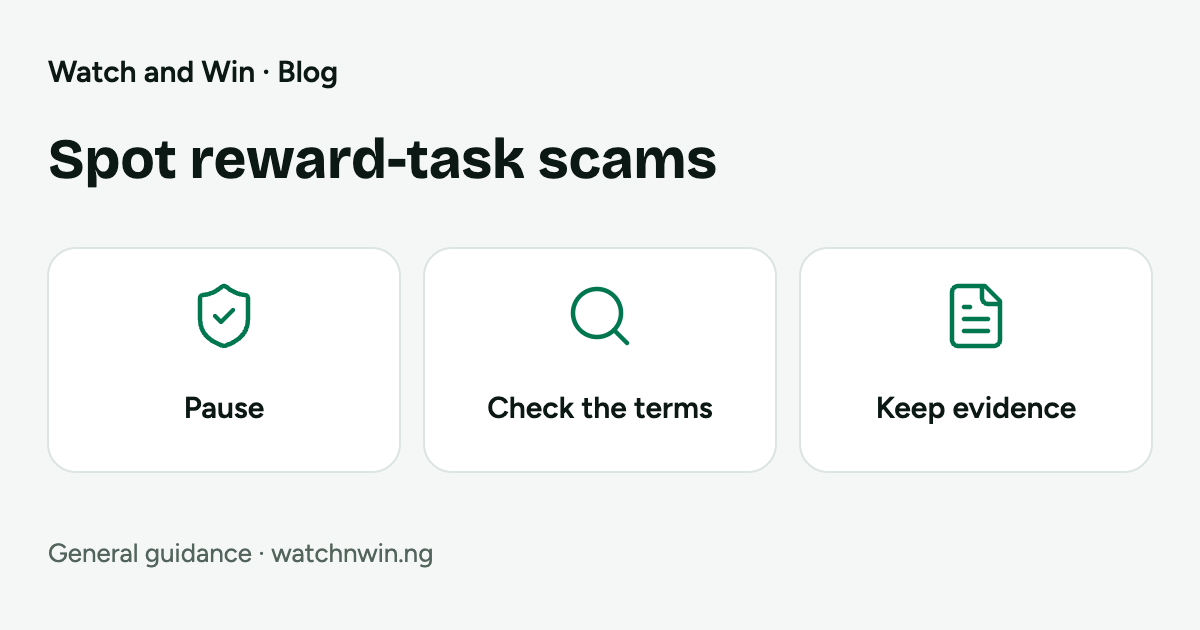
Watch and Win is still in development. This guide describes general concepts, not a live service or a promise of earnings.
Before you start
Pause if an online task asks you to send money to unlock earnings. A balance on a screen is not proof that money is available. Check the website independently, read the reward conditions and keep your banking credentials private.
What does a reward-task scam look like?
A task scam uses simple online activities and a convincing earnings screen to persuade someone to deposit their own money. The US Federal Trade Commission describes messages offering tasks such as “product boosting”, followed by demands for deposits to release supposed earnings. A small early payment can be part of the deception. Source: FTC, How to spot and avoid task scams.
For a reader in Nigeria, translate the sales pitch into a concrete question: what exactly must leave my bank account before anything reaches it? A request for an unlock payment to an individual should stop the process. A professional-looking site, naira symbol or payment screenshot cannot answer that question for you.
What should you check before accepting an offer?
Use a short written checklist before spending time, data or money. The point is to understand the conditions while you can still walk away. These are our practical checks, not a certification that any platform is safe.
- Find the site independently. Type the known address yourself. Compare the domain with the one in the message, including spelling. Open support from the site rather than a forwarded chat link.
- Write down the task and reward. Record eligibility, deadline, required purchases, subscriptions and withdrawal conditions. If the wording is unclear, ask before starting.
- Separate an offer purchase from an unlock demand. A disclosed shopping offer may require a purchase. That is a cost you must evaluate. A later demand to transfer money to release a balance is a different warning sign.
- Identify who handles problems. Find a working support route and the provider’s terms. Ask who can investigate missing credit and what evidence they require.
- Keep your own record. Save the original conditions and your completion evidence. Hide sensitive details before sending screenshots.
Do not share your debit-card PIN or give another person remote access to your banking app. The Central Bank of Nigeria’s consumer guide warns against disclosing card details and PINs, and advises verifying messages claiming to come from a bank. Source: CBN, Managing accounts, page 13. Use contact details you already trust to check a suspicious banking request.
A simple decision example
Imagine a task dashboard shows ₦8,000, then a chat agent asks for ₦2,000 to “activate withdrawal”. This is an illustrative scenario, not a Watch and Win offer or a report from a user. Stop the transaction and verify independently. Sending the extra money does not establish that the displayed balance exists.
If an ordinary reward has simply not arrived, use a different process: check the original conditions and collect evidence. Our guide to pending offerwall rewards explains that distinction. Do not let a support conversation turn a missing-credit enquiry into a payment demand.
What if you already sent money or shared details?
Contact your bank or payment provider immediately through a known official channel. Describe the transaction and ask what protective steps are available. Keep the transfer reference, recipient details, message history and website address. Acting quickly does not guarantee that funds can be recovered.
If you shared a password, change it from a device you trust and change it anywhere else you reused it. Ask your bank what to do if banking credentials were exposed. Do not send more money because someone promises to recover the first payment. Keep the original records rather than editing them.
Common questions
Does a small first payout prove a task app is legitimate?
No. Assess the whole process, including later payment demands and withdrawal conditions. A successful transfer establishes only that one transfer happened. It does not prove the next balance is withdrawable or that a platform has the approval it claims.
Does HTTPS mean an offer is safe?
HTTPS protects the connection to the address you opened. It does not establish that the operator will honour a reward. Check the address, terms and independent evidence as well.
Can I earn or withdraw from this Watch and Win preview?
Treat the website as a demonstration. The application is still being developed. Sample offers and balances are not evidence of live rewards, completed payouts or approved financial services.
Sources and scope
Sources consulted on 28 October 2026: the FTC task-scam warning and the CBN account-management guide linked above. The FTC describes a scam pattern; it is not a Nigerian regulator. The checklist and scenario are our practical guidance. This article does not determine whether a particular company is licensed or lawful.